
Views: 0 Author: Site Editor Publish Time: 2026-07-24 Origin: Site


TL;DR:
A broken strut mount disrupts steering precision, accelerates tire wear, and can damage adjacent suspension components if left unaddressed. Engine mount failure compounds the problem by allowing the powertrain to shift under load. Recognizing the warning signs early—and sourcing quality replacement parts—prevents minor issues from becoming costly repairs.
Suspension failures rarely announce themselves dramatically. More often, they creep in as a faint clunk over speed bumps, a slight pull during cornering, or a vibration that settles into the steering wheel at highway speeds. By the time most drivers investigate, the damage has already spread beyond the original component.
Understanding what connects strut mounts to engine mounts—and what their failure signatures look like—gives technicians and sourcing professionals a clearer picture of where quality matters most. It also explains why choosing a manufacturer with deep engineering experience makes a measurable difference in product longevity.

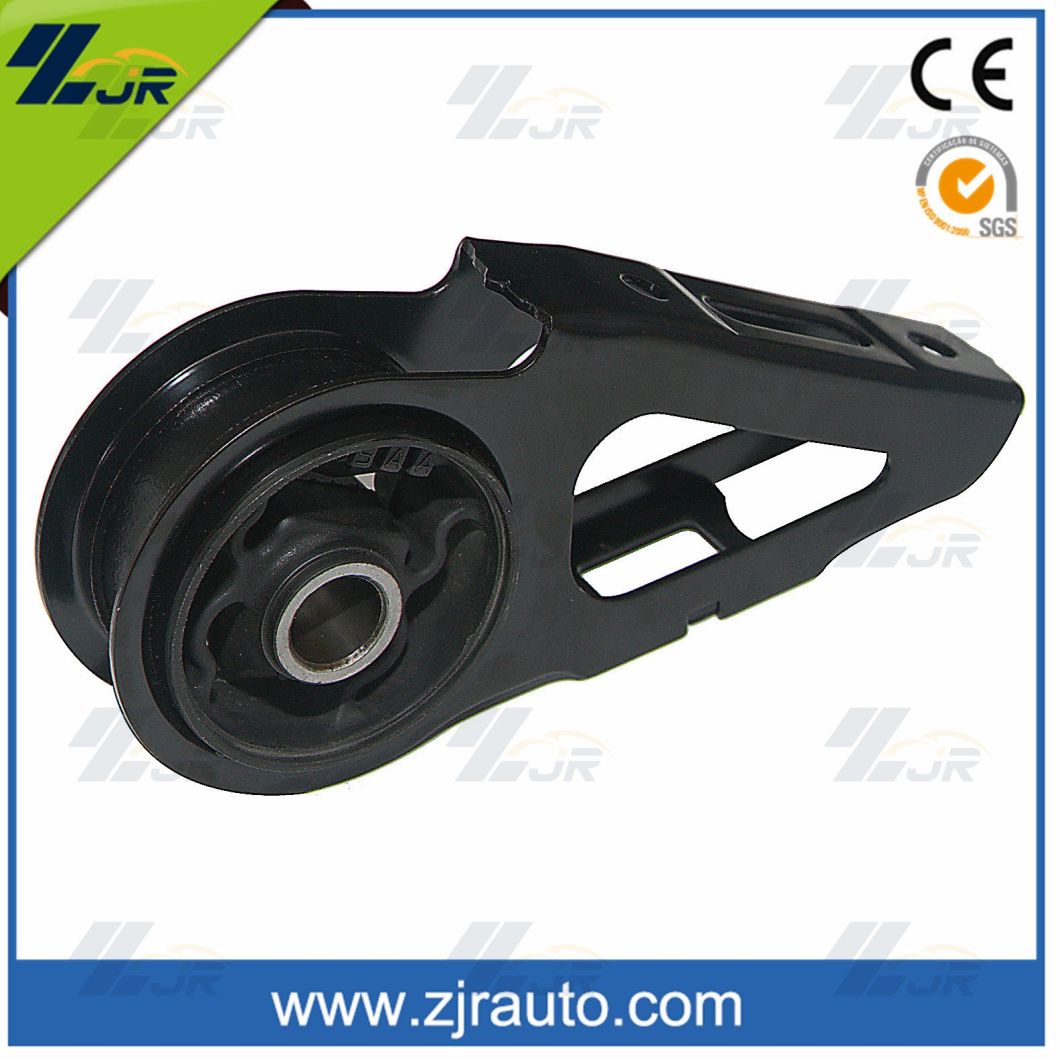
A strut mount sits at the top of the front suspension strut assembly, connecting the strut to the vehicle chassis. Its job is twofold: it absorbs shock from the road surface and allows the strut to rotate smoothly as the steering wheel turns. The mount itself is a rubber-bonded metal unit, engineered to flex within specific tolerances while maintaining structural integrity over tens of thousands of miles.
A broken strut mount disrupts both functions simultaneously. The rubber element cracks or separates from the metal housing, eliminating the cushioning effect and locking or loosening the pivot point. The result is a steering system that feels imprecise, a ride that transmits every road imperfection directly into the cabin, and uneven tire contact that shortens tread life. On vehicles with MacPherson strut front suspensions—which covers the majority of Asian-make passenger cars—a failed strut mount puts added stress on the bearing plate, the strut rod, and the coil spring seat.
The failure mode matters for sourcing decisions. Mounts that use low-density rubber compounds or inadequate metal bonding degrade faster under thermal cycling and load variation. ZHIJIE AUTOPARTS (ZJR Auto), a manufacturer founded in 1993, addresses this with a vulcanization process that bonds high-durometer natural rubber directly to precision-stamped steel housings. The result is a mount that maintains its rated deflection characteristics across a temperature range from -40°C to 120°C—conditions that cover the operational extremes of most markets.

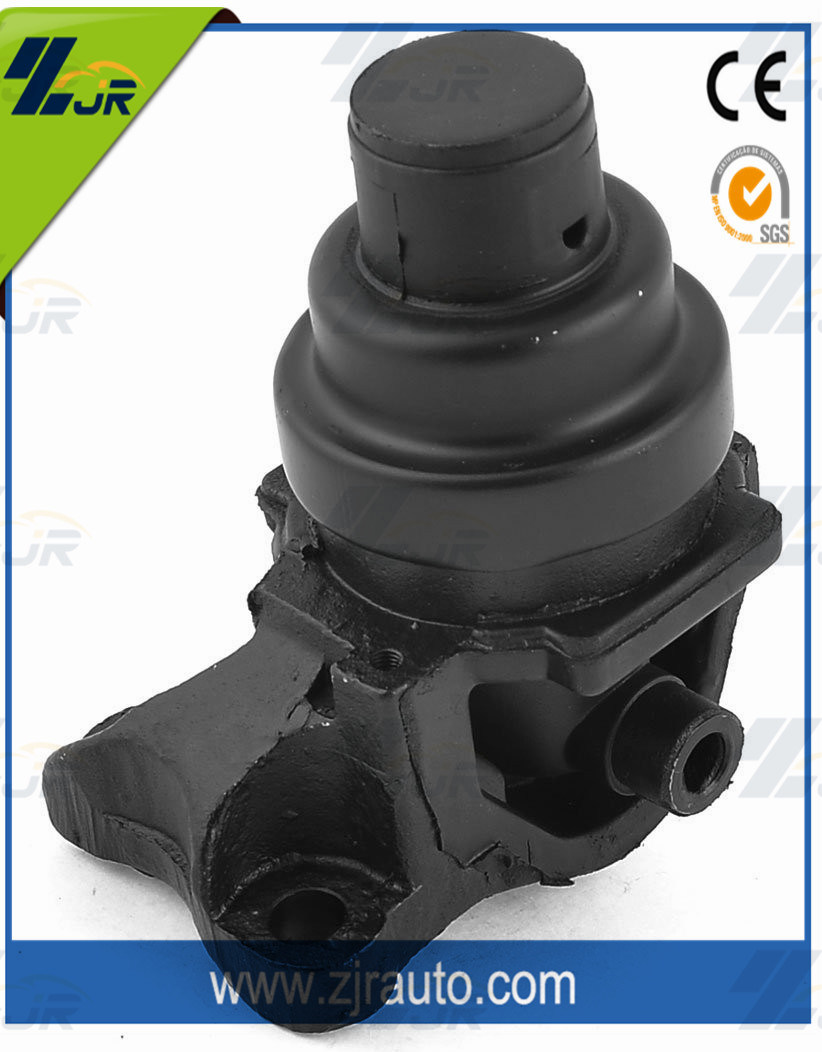
Strut mount wear rarely occurs in isolation. Vehicles with high mileage or poor road conditions often show concurrent deterioration across multiple rubber-bonded components, including engine mounts. Recognizing bad engine mount symptoms alongside strut mount issues helps technicians prioritize repairs and prevents misdiagnosis.
The table below outlines the most common failure signs for both component types, organized by how they present during driving:
Symptom | Strut Mount Failure | Engine Mount Failure |
|---|---|---|
Clunking noise | Over bumps, during braking | During acceleration or gear changes |
Vibration | Felt through steering wheel | Felt through floor/cabin at idle |
Visual inspection | Cracked rubber, separated housing | Torn or collapsed rubber insert |
Handling change | Pulling, loose steering feel | Powertrain shifts on hard acceleration |
Tire wear pattern | Uneven or cupped tread | Generally unaffected |
Severity if ignored | Bearing and spring seat damage | Drivetrain component stress |
Engine mounts serve a parallel structural role to strut mounts—they isolate and secure a dynamic assembly using rubber-to-metal bonded units. When the rubber core collapses or tears, the engine shifts position under load. This misalignment stresses CV joints, exhaust connections, and transmission linkages. On older Honda platforms in particular, the front and rear engine mount positions are tightly engineered, leaving little tolerance for movement outside design parameters.
Japanese-make vehicles—Toyota, Honda, Nissan, Mazda, and Suzuki among them—dominate the replacement parts demand across Southeast Asia, the Middle East, and Oceania. These platforms share one characteristic that distinguishes them from European designs: tight dimensional tolerances at mounting interfaces. A mount that is even marginally undersized at the sleeve diameter or mounting bracket will allow micro-movement that accelerates wear on the surrounding hardware.
ZJR Auto's product catalog of over 2,000 SKUs is built primarily around Japanese-make fitments, developed against OEM dimensional data. For Honda Accord owners sourcing 1999 honda accord lx engine mounts, this precision matters because the Accord's F-series engine mount positions were carried across multiple generations with minor modifications. A mount engineered to OEM tolerances installs without modification and maintains correct powertrain geometry from the first drive cycle.
ZJR Auto supplies wholesale buyers with a minimum order structure (MOQ from 50 to 150 units depending on SKU), T/T and L/C payment options, and an electronic catalog for efficient part number cross-referencing. For distributors and repair workshops sourcing across multiple vehicle lines, the company's breadth of coverage across Toyota, Nissan, Suzuki, Hyundai, Mitsubishi, and Honda reduces the number of suppliers required to maintain adequate stock.
Parts quality is ultimately determined upstream—at the material specification stage and the tooling design stage—not at the inspection stage. ZJR Auto's three-decade manufacturing history reflects a production philosophy built on process control rather than post-production sorting.
The company's strut mounts and engine mounts use iron castings and steel stampings that are machined in-house to maintain dimensional consistency across production runs. Rubber formulation is matched to the application: harder compounds for high-load engine mount positions, softer formulations for strut mounts where isolation from road noise is the primary requirement. Each assembly undergoes a load-deflection test to verify that the rubber element will perform within specification under static and dynamic loading.
For wholesale buyers evaluating supplier reliability, ZJR Auto's participation in international trade exhibitions—including AAPEX in Las Vegas and Automechanika in Shanghai—reflects a commitment to market transparency and technical accountability that smaller or newer suppliers typically cannot match.
The clearest guidance for replacement timing: address strut mount and engine mount wear together when the vehicle is already lifted for suspension service. Labor overlap is significant, and the root causes of wear—age, heat cycles, road conditions—affect both component types equally. Delaying one repair after addressing the other typically means returning to the same repair bay within 12 to 18 months.
For workshops and distributors sourcing parts at scale, working with a manufacturer that controls the full production chain—from raw materials to finished assembly—eliminates the quality variability that comes with multi-tier supply chains. ZJR Auto's wholesale model is designed precisely for this kind of partnership: consistent specifications, documented fitment data, and the production capacity to support recurring orders without lead time unpredictability.
Visit zjrauto.com to download the electronic catalog or submit a product inquiry directly to the ZJR Auto team.
What are the most common signs of a failing strut mount?
The most consistent indicators are clunking or knocking sounds when driving over bumps, a loose or imprecise steering feel, and vibration transmitted through the steering wheel. In advanced failure cases, uneven tire wear appears on the front axle.
How long do strut mounts typically last?
On most passenger vehicles, strut mounts last between 50,000 and 100,000 miles. Vehicles operated on rough roads or in extreme temperature climates will see shorter service intervals.
Can a bad engine mount cause steering problems?
Directly, no. But severe engine mount failure allows enough powertrain movement to stress CV joints and shift exhaust routing, which can create secondary symptoms that overlap with steering or suspension complaints. Accurate diagnosis requires inspecting both systems.
What should wholesale buyers look for when evaluating strut mount and engine mount suppliers?
Prioritize suppliers with documented OEM dimensional references, in-house rubber compounding or a defined rubber specification, and production history across multiple vehicle platforms. Fitment accuracy and material consistency are more reliable quality indicators than price alone.
Does ZJR Auto supply parts for both strut mounts and engine mounts across multiple brands?
Yes. ZHIJIE AUTOPARTS carries strut mounts and engine mounts for Toyota, Honda, Nissan, Mitsubishi, Suzuki, Hyundai, Mazda, Subaru, Daihatsu, Renault, and additional brands, with over 2,000 SKUs available for wholesale purchase.