
Views: 0 Author: Site Editor Publish Time: 2026-04-29 Origin: Site


The automotive industry is built on the foundation of precision engineering and mechanical synergy. Every time you turn the key or press the push-start button, thousands of individual components must work in perfect harmony to provide a safe and comfortable ride. For vehicle owners and fleet managers, the challenge often lies in sourcing reliable auto parts that meet or exceed Original Equipment Manufacturer (OEM) standards.
Quality is not just a luxury in the automotive world; it is a fundamental requirement for safety. Whether it is the rubber in an engine mount absorbing vibrations or the complex geometry of a suspension bushing, the integrity of these parts determines how a vehicle handles emergency maneuvers and how long the chassis survives the rigors of daily driving.
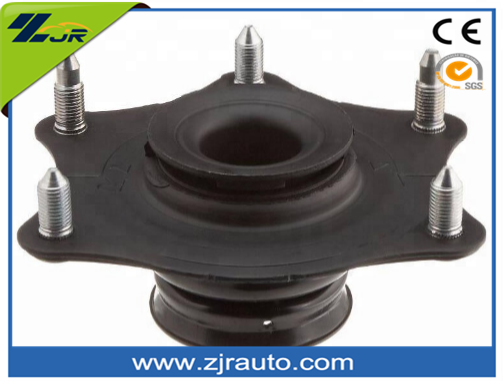

Modern vehicles rely heavily on rubber-to-metal components to dampen vibrations and reduce Noise, Vibration, and Harshness (NVH). These car parts act as the silent protectors of the vehicle's structural integrity. Engine mounts, for instance, are designed to hold the heavy mass of the powertrain while isolating the cabin from the high-frequency tremors of combustion.
The science behind these components involves sophisticated rubber formulations. High-quality parts utilize natural rubber with specific additives that prevent aging and cracking due to extreme temperature fluctuations. When a mount or bushing fails, the resulting vibrations can lead to premature wear on other critical systems, such as the transmission and the exhaust manifold, turning a minor maintenance issue into an expensive repair.
One of the most vital yet frequently overlooked components in the suspension assembly is the shock mount (often technically referred to as a strut mount). This component serves as the connection point between the vehicle's shock absorber and the chassis. It acts as an insulator, preventing the harsh impact of potholes and road debris from being transmitted directly into the steering system and the body of the car.
A worn-out mount can manifest in several ways:
Clunking Noises: A hollow thumping or knocking sound when driving over bumps.
Vibration through Steering: A loss of that "connected" feel between the driver and the road.
Uneven Tire Wear: Poor alignment caused by a collapsing mount can lead to tires wearing out prematurely.
Steering Memory: The car fails to return to center easily after a turn.


To help professional buyers and DIY enthusiasts understand the differences in component roles, the following table summarizes the primary suspension and engine parts provided by ZJR Auto:
| Component Type | Primary Function | Materials Used | Typical Service Life (km) |
| Engine Mount | Isolates engine vibration from the cabin | Natural Rubber & High-Strength Steel | 80,000 – 120,000 |
| Strut / Shock Mount | Connects suspension to chassis; dampens road shock | High-Density Rubber & Aluminum/Steel | 100,000 – 150,000 |
| Suspension Bushing | Allows movement in control arms; reduces friction | Bonded Rubber & Metal Sleeves | 60,000 – 100,000 |
| Stabilizer Link | Reduces body roll during cornering | Steel / Reinforced Plastic | 50,000 – 80,000 |
In the global market for automotive spares, durability is highly dependent on environmental conditions. Parts designed for the tropical humidity of Southeast Asia must have different corrosion resistance profiles than those destined for the salted winter roads of North America or Europe.
ZJR Auto focuses on Japanese models—including Toyota, Honda, and Nissan—where the tolerances for rubber-to-metal bonding are extremely tight. For instance, a stabilizer bushing must maintain its elasticity within a specific range of shore hardness ($70A$ to $80A$) to ensure the anti-roll bar functions as intended without becoming brittle.
Replacing a single failed part is often not enough to restore a vehicle to its optimal state. Experts recommend the following:
Replace in Pairs: If one front shock mount has failed, the other is likely nearing the end of its lifespan. Replacing them together ensures balanced handling.
Verify OEM Numbers: Always check the specific part number (e.g., 12361-16210 for Toyota) to ensure a perfect fit.
Alignment after Suspension Work: Any time the suspension is disassembled to replace mounts or bushings, a professional wheel alignment is necessary to prevent tire damage.
The pursuit of automotive excellence is a journey of thousands of miles, powered by the reliability of high-grade auto parts. By understanding the critical functions of car parts like the engine mount and the shock mount, owners can take proactive steps to ensure their vehicle remains safe, quiet, and efficient. Investing in quality today prevents the mechanical failures of tomorrow, keeping our roads safer for everyone.